Catching a spider: Automating the Spider Algorithm in Complex Dynamics
Wayne Peng
National Central University
Now run the process backward
Choose a point $t$. First solve $f(x)=t$, then solve $f^2(x)=t$, and continue.
$t \leftarrow f^{-1}(t) \leftarrow f^{-2}(t) \leftarrow \cdots$
The answers branch into a tree. The preimage of a loop from $t$ around a critical point is a path connect branches.
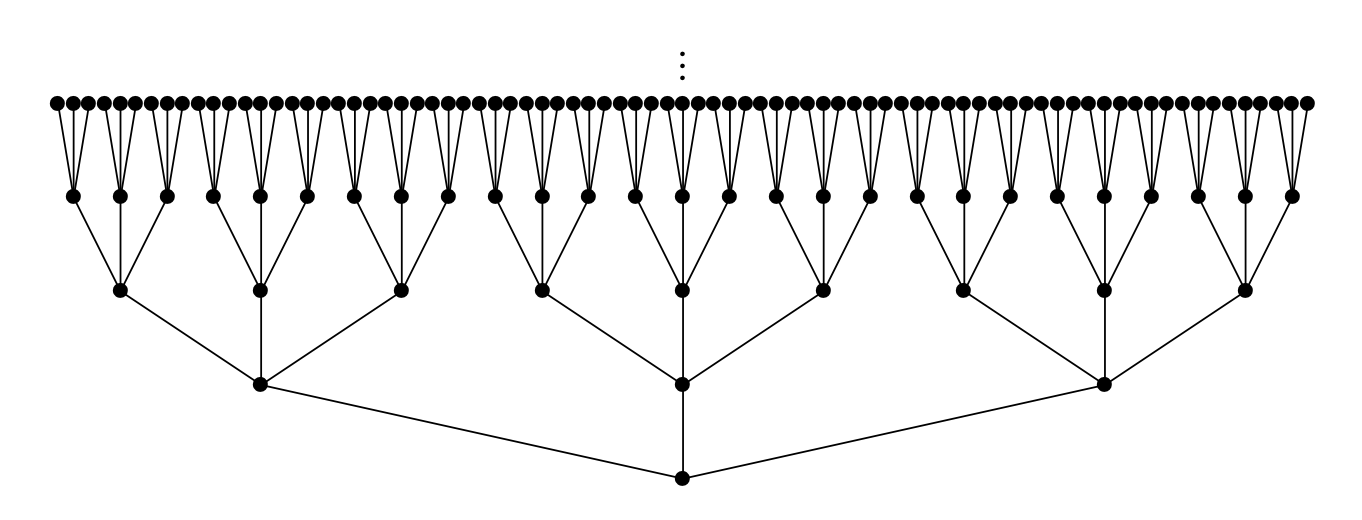
The iterated monodromy group records all of these shuffles. $$ \rho_f \colon \pi_1\!\left(\mathbb{P}^1(\mathbb{C})\setminus P_f,\,t\right) \longrightarrow \operatorname{Aut}(T_f), $$
Why introduce a spider?
We need a consistent way to draw one loop around each critical point.
Draw non-crossing paths from one common base point. Travel out along one leg, circle its endpoint, and return along the same leg.
This collection of legs is a spider.
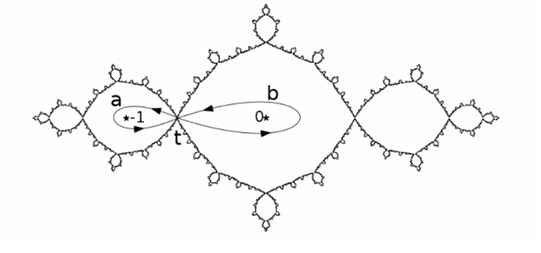
Key idea: replace the picture by a graph
Pull the spider backward through the function. The result is an embedded graph, which I call the web.
The web records only finite information:
- which important points are connected;
- which paths share a vertex;
- the clockwise order of edges around each vertex.
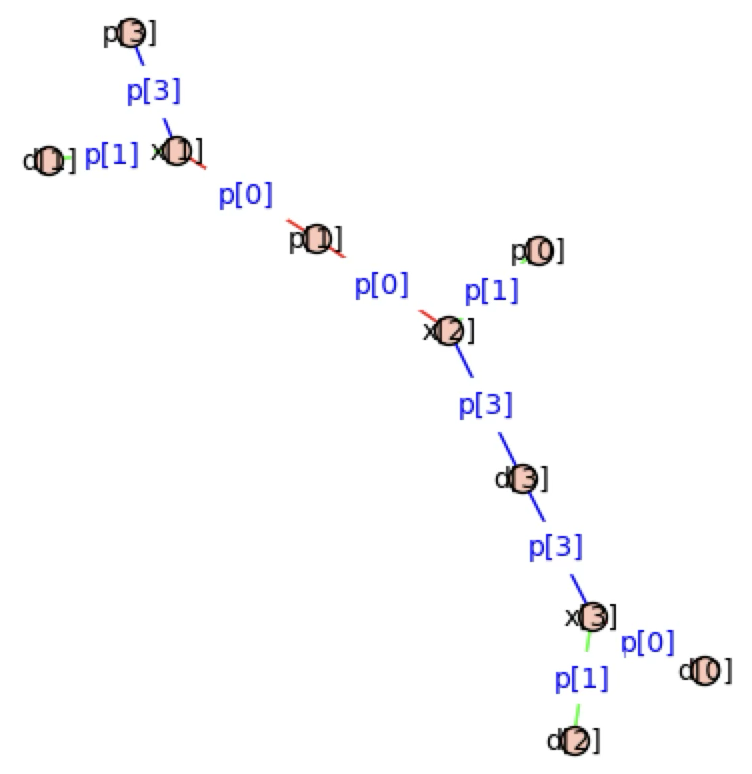
The continuous deformation problem is now a finite graph-search problem.
Example: $f(x)=2x^3-3x^2+1$
Pulled-back web
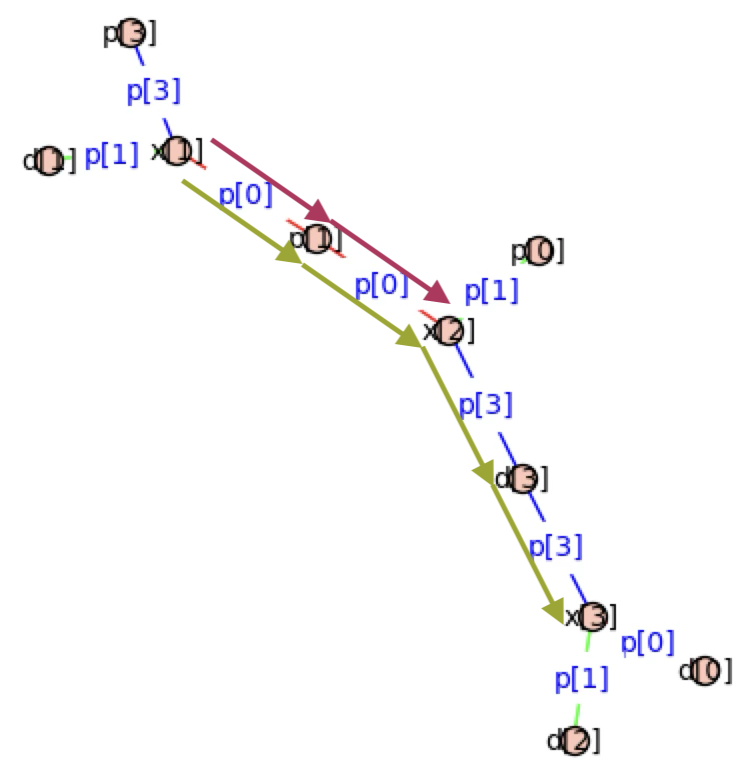
Compatible paths found by the search
Why this matters
$\Downarrow$
finite graph + path search + clockwise order
$\Downarrow$
a compact automaton describing infinitely many tree symmetries
Thank you!